
Location and placement of fence
- Fences shall be erected entirely within the confines of the property boundary line of the property to which it is to serve and shall not extend or overhang onto an adjoining property without permission of the adjoining property owner or public property or right-of-way. It is the responsibility of the property owner to maintain the grass and weeds between the fence and the property boundary line.
- Fences may be placed across easements but may not block or impede the flow of drainage. Any fence placed across easements may be removed at the owner’s expense.
- Fences shall be placed securely within the ground to minimize damage to structures within the fence enclosure and adjoining property(ies) that may result from high wind forces.
Fence Heights
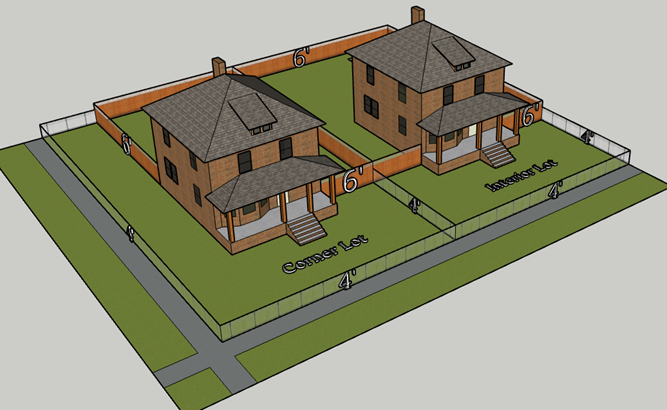
- Reference illustration below.
- Street-facing yards.
- The fence may not exceed 4 feet in height.
- This shall apply to any fence between the structure and the street.
- All other yards.
- The fence may not exceed 6 feet in height.
Fence Obstruction
The erection of a fence shall not obstruct the minimum sight distance of two hundred feet (200′) required to adequately egress the property to which the fence shall serve, nor an adjoining property owner.
Fence Materials
- A finished side of all fences shall face off-site.
- Razor wire, concertina wire, barbed wire, and similar fencing materials shall be prohibited in, and directly adjacent to, all residential districts and uses, including those separated by a public right-of-way.
- The use of chain link fences in yards fronting public streets is prohibited, including side yards on corner lots.
- Fences in front of the residences and on any corner lot abutted by a public street, no type of wire, mesh, chain, or any such material may be used as the primary fencing material.
- Fences along public streets and alleys shall be brick, rock, wrought iron, finished wood, and vinyl.
The use of pallets or pallet materials are prohibited.
Fence Maintenance
- Any fence that has any of the following conditions, such that the life, health, property, or safety of the property owner and/or tenant or the general public are endangered.
- Stress in any material, member, or portion thereof, due to all imposed loads including dead load exceeds the stresses allowed in recognized construction practices and standards and specifications.
- The fence or a portion thereof has been damaged due to flood, wind, or other cause to the extent that the structural integrity of the fence is less than it was prior to the damage and is less than the minimum requirement established in recognized construction practices and standards and specifications for new fences.
- Any portion of the fence is not securely fastened, attached, or anchored such that it is capable of resisting wind or similar loads.
- The fence or portion thereof as a result of decay, insect infestation, deterioration or dilapidation is likely to fully or partially collapse.
- The code administrator shall inspect or cause to be inspected any fence which is or may be unsafe. After the code administrator has inspected or caused to be inspected a fence or portion thereof and has determined that such fence or portion thereof is unsafe, he shall initiate through proper notification and cause the abatement of the unsafe condition(s) in the fence by repair, replacement, demolition, or combination thereof.
- It shall be the responsibility of the property owner and/or tenant to make all necessary repairs to correct those deficiencies identified by the code administrator in making the determination that the fence is unsafe within a reasonable time period specified by the code administrator.
Downloadable Version of Residential Fence Requirements
Question?
Please contact the Planning & Codes Department at (931) 359-4013 or visit the office a 505 N. Ellington Parkway on the south end of the gas Gas Department building. Office Hours are from 8:00am to 4:00pm Monday through Friday.